






By Simbarashe Namusi
At 5PM, Harare often feels less like a capital city and more like a city negotiating with collapse.
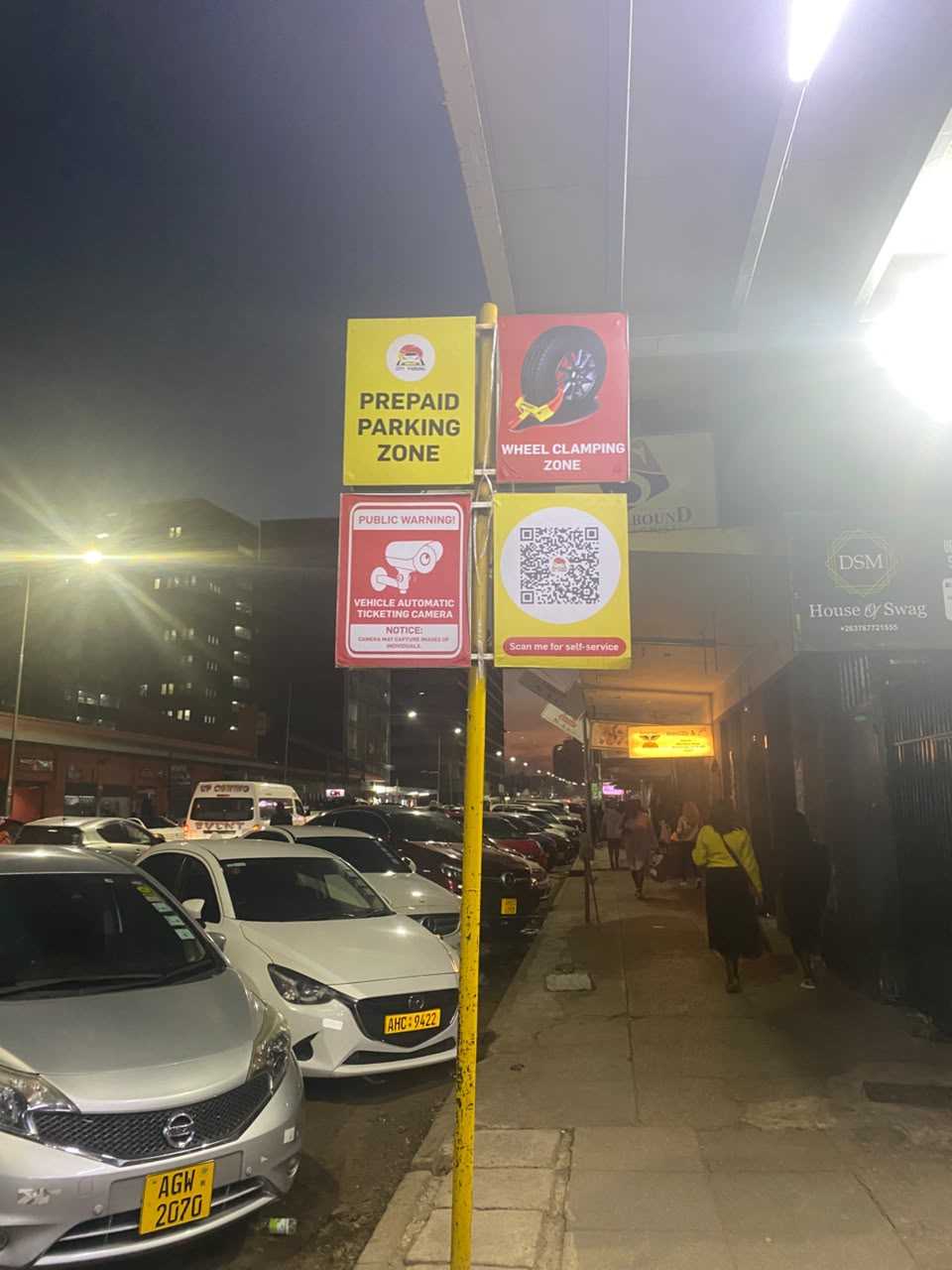
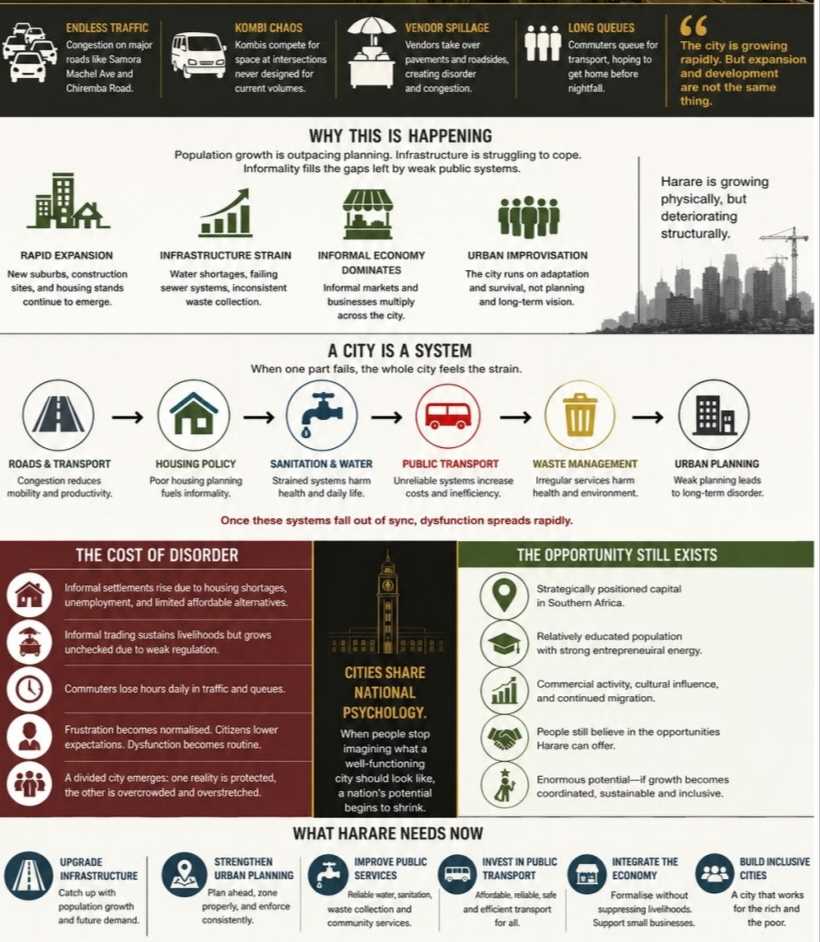
Traffic stretches endlessly along Samora Machel Avenue and Chiremba Road. Kombis fight for space at intersections never designed for current volumes. Vendors spill onto pavements and roadside shoulders. Commuters stand in long queues, hoping to get home before nightfall. Entire suburbs move slowly through congestion that has become so normalised that many residents barely question it anymore.
The city is growing rapidly. But expansion and development are not the same thing.
A city can grow physically while deteriorating structurally. In many ways, that is exactly what is happening in Harare today.
New suburbs continue emerging. Construction sites appear across the city. Informal businesses dominate major roads. Housing stands are constantly being advertised. On the surface, Harare looks busy, energetic, and alive.
But beneath that activity lies a deeper urban crisis: population growth is outpacing planning, infrastructure is struggling to cope, and informality increasingly fills the gaps left by weak public systems.
The result is a city that often feels permanently overwhelmed by its own expansion.
One sees this most clearly on the roads. Entire residential areas have emerged in places where transport infrastructure was never meaningfully upgraded to support increased traffic volumes. Commuters now spend enormous portions of their lives navigating transport inefficiency. The city keeps expanding outward, but mobility within it continues deteriorating.
Roads alone, however, are only one symptom.
Water shortages remain common across many suburbs. Sewage infrastructure struggles under increasing pressure. Waste collection has become inconsistent in several parts of the city. Informal markets continue multiplying because formal economic structures cannot absorb growing urban populations.
What emerges is not coordinated urban development but urban improvisation.
Harare increasingly operates through adaptation rather than planning.
This is especially visible in the rise of informal settlements and unregulated commercial spaces. In many cases, people are not necessarily choosing informality because they prefer it. They are responding to housing shortages, unemployment, bureaucratic obstacles, and limited affordable alternatives.
The city’s growth is therefore being shaped less by long-term urban vision and more by immediate survival pressures.
That creates dangerous long-term consequences.
Cities are not simply collections of buildings and people. They are systems. Roads connect to housing policy. Housing connects to sanitation. Sanitation affects public health. Public transport influences productivity. Waste management shapes environmental sustainability. Urban planning determines whether economic activity becomes efficient or chaotic.
Once these systems begin falling out of sync, dysfunction spreads rapidly.
Related Stories
Harare increasingly shows signs of that strain.
The tragedy is that the city still possesses enormous potential. Harare remains one of Southern Africa’s most strategically positioned capitals. It has a relatively educated population, strong entrepreneurial energy, cultural influence, and significant commercial activity. Despite economic difficulties, the city continues attracting migration, investment, and business activity.
People still believe opportunity exists in Harare.
But opportunity without planning eventually produces disorder.
One only needs to observe the city’s growth patterns. New residential areas emerge before roads, drainage systems, schools, clinics, or reliable public transport are fully established. Commercial activity follows population growth organically, often without sufficient regulation or supporting infrastructure.
The result is a capital increasingly defined by reactive management instead of proactive development.
Even the informal economy reflects this contradiction. Informal traders continue sustaining thousands of households and keeping commerce alive. Yet the uncontrolled expansion of vending spaces also reflects the inability of formal urban systems to absorb economic pressure effectively.
Citizens are once again being forced to individually solve structural problems.
And yet, despite these visible pressures, Harare continues projecting ambition. Luxury apartment developments emerge alongside collapsing roads. Modern office spaces coexist with unreliable water supply. Private schools expand while public infrastructure deteriorates. The city increasingly reflects two parallel urban realities existing side by side.
One functional and protected. The other overcrowded and overstretched.
That divide carries social and political consequences.
Cities shape national psychology. When residents spend years navigating congestion, poor services, unreliable infrastructure, and unplanned growth, frustration eventually becomes normalised. Citizens lower expectations. Dysfunction becomes routine. Survival replaces civic confidence.
Over time, people stop imagining what a properly functioning city should look like.
That may be Harare’s greatest danger.
Because cities are ultimately expressions of national priorities. Well-run cities signal institutional competence, planning capacity, and long-term vision. Poorly managed cities reveal the opposite.
Harare’s future will therefore depend not simply on expansion, but on whether growth can become coordinated, sustainable, and inclusive. Infrastructure must begin catching up with population growth. Urban planning must become more consistent. Public services must recover reliability. Economic activity must be integrated rather than merely tolerated.
Harare does not lack energy. It does not lack people. It does not even lack ambition.
What it increasingly lacks is coherence.
And once a city loses coherence, growth itself can begin to feel like decline.
Simbarashe Namusi is a peace, leadership and governance scholar as well as a media expert writing in his personal capacity.






Leave Comments