








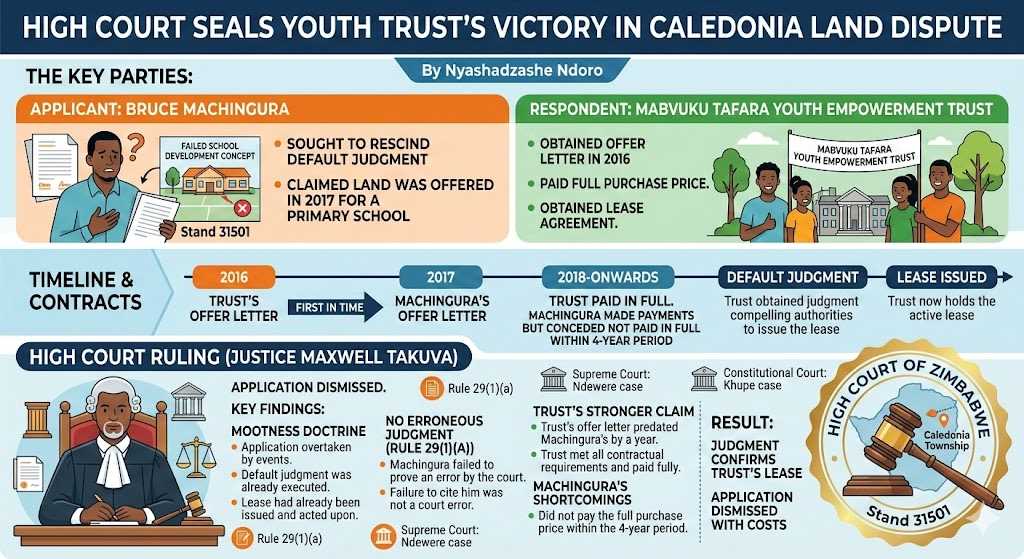
The High Court of Zimbabwe has dismissed an application by Bruce Machingura seeking to rescind a default judgment that granted Mabvuku Tafara Youth Empowerment Trust a lease over a disputed stand in Caledonia Township.
Justice Maxwell Takuva ruled that the rescission application, filed in terms of Rule 29(1)(a) of the High Court Rules 2021, lacked merit and had in any event been overtaken by events.
The dispute centres on Stand 31501, Caledonia Township. The Mabvuku Tafara Youth Empowerment Trust obtained an offer letter for the land in 2016 from the Ministry of Local Government, Public Works and National Housing and the Urban Development Corporation. After paying the full purchase price, the trust sought issuance of a lease agreement.
When this was not forthcoming, it approached the High Court for specific performance and obtained a default judgment compelling the authorities to issue the lease.
Machingura later applied for rescission of that judgment, arguing that his default was not wilful and that he had a bona fide defence. He said he had been offered the same stand in January 2017 for the development of a primary school and had been making payments since 2018. He contended that the order granted in favour of the trust conflicted with his interests and that he had not been cited or served in the original proceedings.
He further argued that the trust had incorrectly cited itself and had no rights over the land. According to Machingura, the balance of convenience favoured setting aside the order.
The trust opposed the application, raising a preliminary point that the matter had become moot because the lease agreement had already been issued and acted upon. It maintained that it had received its offer letter first, paid the full purchase price within the stipulated period and had been in occupation of the stand since 2016. The trust also argued that Machingura had failed to pay the full purchase price within the four-year period provided in his offer letter and therefore had no prospects of success.
Related Stories
In addressing the doctrine of mootness, Justice Takuva relied on the Supreme Court of Zimbabwe decision in Ndewere v President of Zimbabwe NO & Ors and a ruling by the Constitutional Court of Zimbabwe in Thokozani Khupe & Anor v Parliament of Zimbabwe & Ors, which held that courts may decline to exercise jurisdiction where a dispute has become academic due to changed circumstances.
The judge found that the order sought to be rescinded had already been executed, as the trust had obtained its lease agreement. As a result, the matter had become moot and academic.
Even if mootness were disregarded, the court held that the application would still fail. Justice Takuva ruled that the default judgment had not been granted erroneously and that Rule 29(1)(a) requires an applicant to demonstrate that the court itself made an error.
“The applicant failed to prove on a balance of probabilities that the default judgement was granted in error,” Justice Takuva said.
The court noted that the failure to cite Machingura was not an error attributable to the court, adding that it is not the court’s duty to identify and join potential parties to proceedings.
The judgment further highlighted that the trust’s offer letter predated Machingura’s by one year and that the trust had complied fully with its contractual obligations, including payment of the purchase price. By contrast, Machingura conceded that he had not settled the full amount within the stipulated four-year period.
Justice Takuva also observed that Machingura was not privy to the contract between the trust and the Ministry and that any remedy available to him lay against the issuing authority rather than through rescission of the judgment. The court pointed out that the relief sought did not include cancellation of the lease agreement, which would require a separate application.
The application for rescission was dismissed with costs.









Leave Comments