






Despite global commitments, female genital mutilation/cutting remains a persistent and growing human rights crisis.
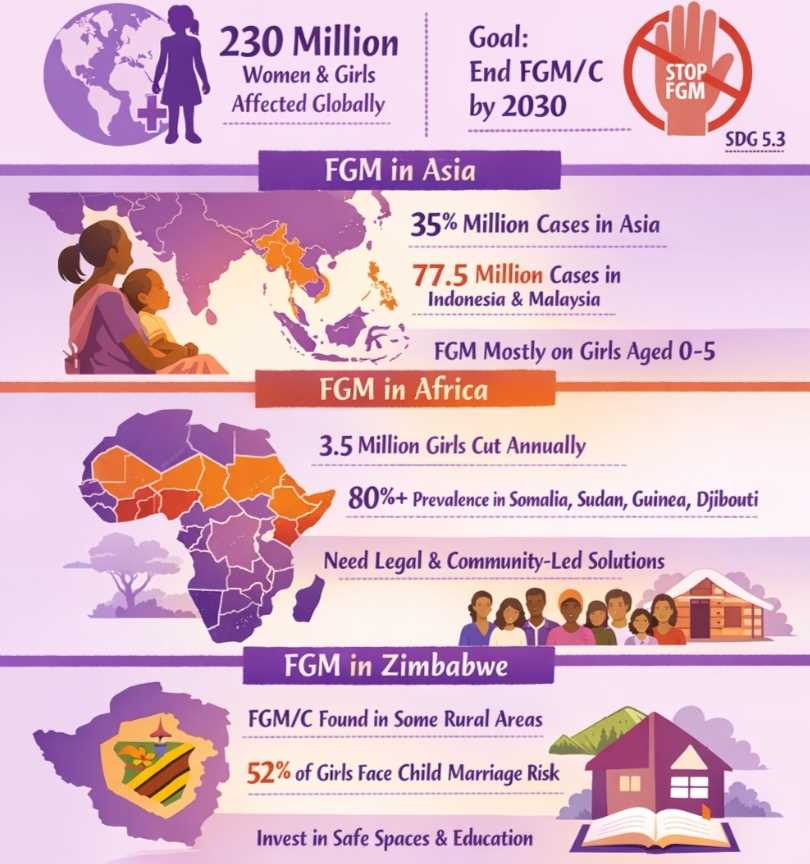
Rates have increased by 15% over the past eight years, from 200 million girls in 2016 to over 230 million in 2024, with one-third of cases occurring in Asia.
With only 58 months left to #KeepThePromise, advocates warn urgent action is needed to protect girls’ health, rights, and dignity worldwide.
These concerns were central to the February 2026 SHE & Rights session, hosted ahead of the 70th UN Commission on the Status of Women (CSW70) and marking the 20th anniversary of the Universal Periodic Review.
“When we speak about violence and human rights violations, FGM/C is among the most heinous crimes,” said Shobha Shukla, SHE & Rights Host and CNS Executive Director. “All world leaders globally promised to end FGM/C by 2030, yet rates continue to rise.
One-third of cases happen in Asia, affecting approximately 80 million girls. The countdown is on, and we must act now.”
Survivor Voices: Personal Pain, Public Advocacy
For Catherine Menganyi HSC, a nurse epidemiologist and FGM/C survivor from Kenya, the fight against the practice is deeply personal.
“My journey to end FGM/C did not begin in an office. It began where the pain was raw — in my own life,” Catherine said. “As a young girl, I underwent medicalised FGM/C. The trauma is still vivid, but I now use my experience to protect more than a thousand girls I’ve encountered, ensuring they do not suffer the same fate.”
Catherine stressed community-led solutions. “Affected communities understand why harmful practices occur and are best placed to find locally relevant solutions. Investing in these responses is not charity — it is justice. Every girl and woman has the right to grow up whole, safe, educated, and free from violence.”
She also highlighted that FGM/C is part of a broader system controlling women and girls’ bodies. “It normalises violence and limits choices. Gender equality is not optional — it must be guaranteed to all women and girls.”
The Asia Challenge: Medicalisation and Harm
Related Stories
Safiya Riyaz, Programme Officer at ARROW and coordinator of the Asia Network to End FGM/C, outlined troubling trends in Asia.
“We are seeing the medicalisation of FGM/C, where healthcare professionals perform the procedure, wrongly legitimising it as ‘medically sound,’” she said. “FGM/C has no health or medical benefits. Social norms around ‘purity’ and controlling female sexuality sustain the practice.”
Safiya highlighted severe physical and psychological harms: “Complications include infections, long-term childbirth pain, sexual dysfunction, and emotional trauma. Type-one FGM/C, which is widespread in Asia, can cause genital swelling, hemorrhage, and lifelong distress.”
Africa bears the heaviest burden of FGM/C. According to UNICEF and WHO, an estimated 3.5 million girls in Africa undergo FGM every year, with countries in East, West, and North Africa recording the highest prevalence rates. Somalia, Sudan, Guinea, and Djibouti report over 80% of women and girls affected, while Kenya, Egypt, and Ethiopia also have significant case numbers.
In Southern Africa, Zimbabwe, Zambia, and Botswana have lower prevalence, but the practice persists in some rural and traditional communities, often linked to rites of passage. Experts stress that ending FGM in Africa requires culturally sensitive approaches, strengthened legal frameworks, and community-led interventions, ensuring girls’ rights to health, education, and bodily integrity are protected.
Mechanisms such as the Universal Periodic Review gave helped maintain pressure on governments.
“UPR has been instrumental, including issuing the first-ever recommendation to India on FGM/C,” said Divya Srinivasan, Global Lead on Ending Harmful Practices at Equality Now. She warned about rising anti-rights pushback in countries like The Gambia, where anti-FGM/C laws face repeal, and in the U.S., where such laws have been misused against gender-affirming care.
“UPR shows that progress is possible, but only when governments are held accountable. Awareness alone is not enough; it must lead to enforceable policy change,” Divya added.
Broader Health and Gender Context
Shobha Shukla also underscored links to broader health challenges. “FGM/C is part of the wider agenda for sexual and reproductive health and rights. Governments must ensure safe, accessible healthcare — from vaccines preventing cervical cancer to early breast cancer screening. Delaying action on health or FGM/C is not just negligence; it endangers lives.”
The Call to Action
With only 58 months remaining until 2030, advocates insist on urgent, community-driven, and government-backed solutions.
“FGM/C is not tradition; it is control. It is not culture; it is violation. Every day it persists, a girl’s right to safety, health, and dignity is stolen,” Catherine Menganyi said.
The SHE & Rights session reminded the global community that ending FGM/C and ensuring menstrual health are urgent, achievable goals — but only if promises translate into action.




Leave Comments