






Zimbabwe’s foreign currency earnings rose sharply to US$16.2 billion in 2025, up from US$13.3 billion in 2024, largely driven by record global gold prices, but the surge has not translated into comfortable external buffers, with foreign exchange reserves covering just 1.5 months of imports, according to the Zimbabwe National Statistics Agency.
ZimStat said the increase in forex inflows reflects stronger export receipts, particularly from minerals, even as reserve adequacy remains weak relative to the country’s import bill.
The agency reported that official forex reserves stood at US$1.2 billion, against average monthly foreign currency payments of about US$956 million, highlighting continued vulnerability to external shocks.
While inflows improved in 2025, Zimbabwe’s reserve position remains modest by regional standards. ZimStat data show that total reserves — combining gold and foreign currency — amounted to just US$472 million in December 2024, underscoring how recent gains are starting from a low base.
Zimbabwe’s reserve accumulation strategy has increasingly leaned on gold. Since 2022, mining companies have been required to pay part of their royalties in physical gold, a policy aimed at strengthening the central bank’s reserve holdings and reducing reliance on volatile cash inflows.
Related Stories
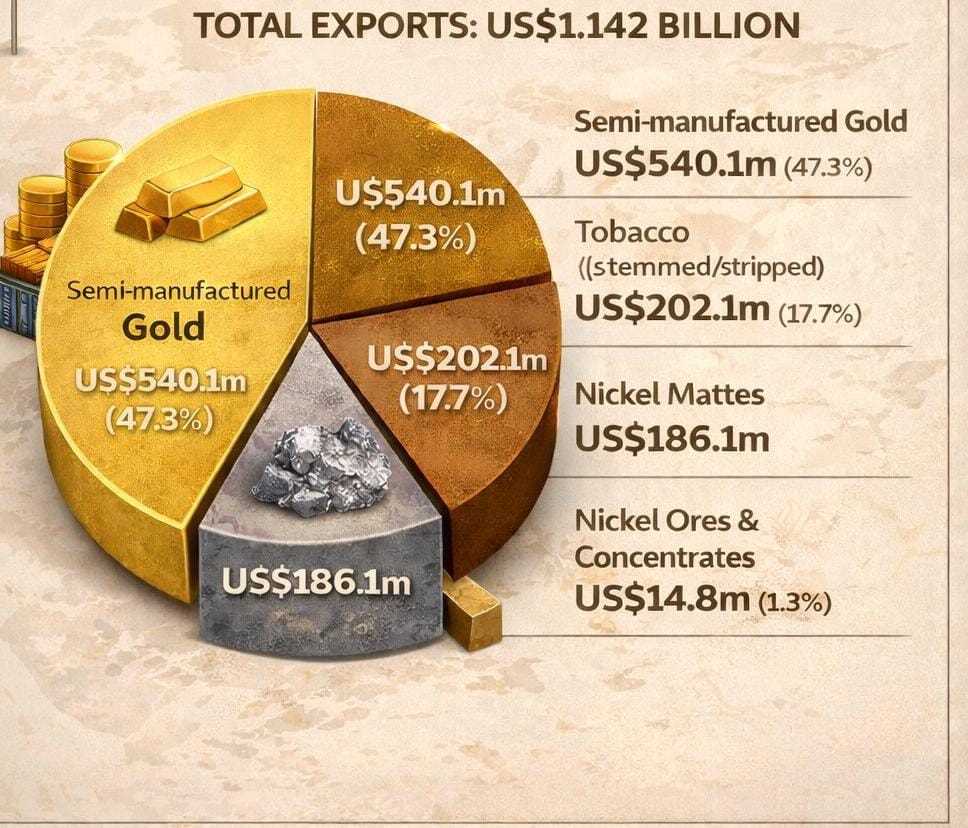
Trade data for December 2025 illustrate the structural drivers behind the forex numbers. ZimStat reported total exports of US$1.142 billion for the month, with semi-manufactured gold dominating at US$540.1 million, accounting for 47.3% of export earnings. Tobacco followed at US$202.1 million (17.7%), while nickel mattes contributed US$186.1 million (16.3%), reinforcing Zimbabwe’s heavy dependence on primary commodities.
Other export earners were significantly smaller, including other mineral substances (US$38.8 million, 3.4%), ferro-chromium (US$33.1 million, 2.9%), other ores and concentrates (US$26.3 million, 2.3%), and nickel ores and concentrates (US$14.8 million, 1.3%).
Manufactured exports remained marginal, with manufactured tobacco products and coke and semi-coke of coal each contributing US$13.7 million (1.2%), while other exports totalled US$64.0 million (5.6%).
On the import side, Zimbabwe spent US$901.5 million in December 2025, underscoring why reserve cover remains tight despite higher forex earnings.
ZimStat said imports were concentrated in mineral fuels, oils and related products (22.6%), followed by machinery and mechanical appliances (13.2%), cereals (6.9%), vehicles (5.7%), and iron and steel products (5.5%). Electricity-related equipment and production inputs also featured prominently, including electrical machinery (4.8%), animal and vegetable fats and oils (4.0%), fertilisers (3.5%), and plastics (3.3%), with other products making up 27.9% of the import bill.
Export destination data further point to concentration risks. Of the US$1.142 billion exported in December, nearly half went to a single market. The United Arab Emirates absorbed US$570.0 million, or 49.9%, reflecting its role as a key hub for Zimbabwean gold. South Africa followed with US$246.7 million (21.6%), while China accounted for US$197.6 million (17.3%).
Smaller shares went to Indonesia (US$16.0 million, 1.4%), the United States (US$8.0 million, 0.7%), and European markets including Belgium (US$6.9 million) and Germany (US$4.6 million), with other destinations collectively accounting for US$87.3 million (7.7%).








Leave Comments