






Questions over governance, valuation discipline, and capital allocation have emerged following plans by the Mutapa Investment Fund to establish a Real Estate Investment Trust —a move aimed at unlocking value from dormant and underutilised state-linked property assets.
The sovereign wealth fund has confirmed plans to create a REIT to consolidate and monetise underperforming properties within its portfolio, including significant real estate assets held by state-owned enterprises such as the National Railways of Zimbabwe and the Cold Storage Company.
Governance and Control Concerns
Regional property consultant Kura Chihota noted that while a REIT can be an effective tool for mobilising capital and professionalising property management, it requires a fundamental shift in control and mindset by sponsors.
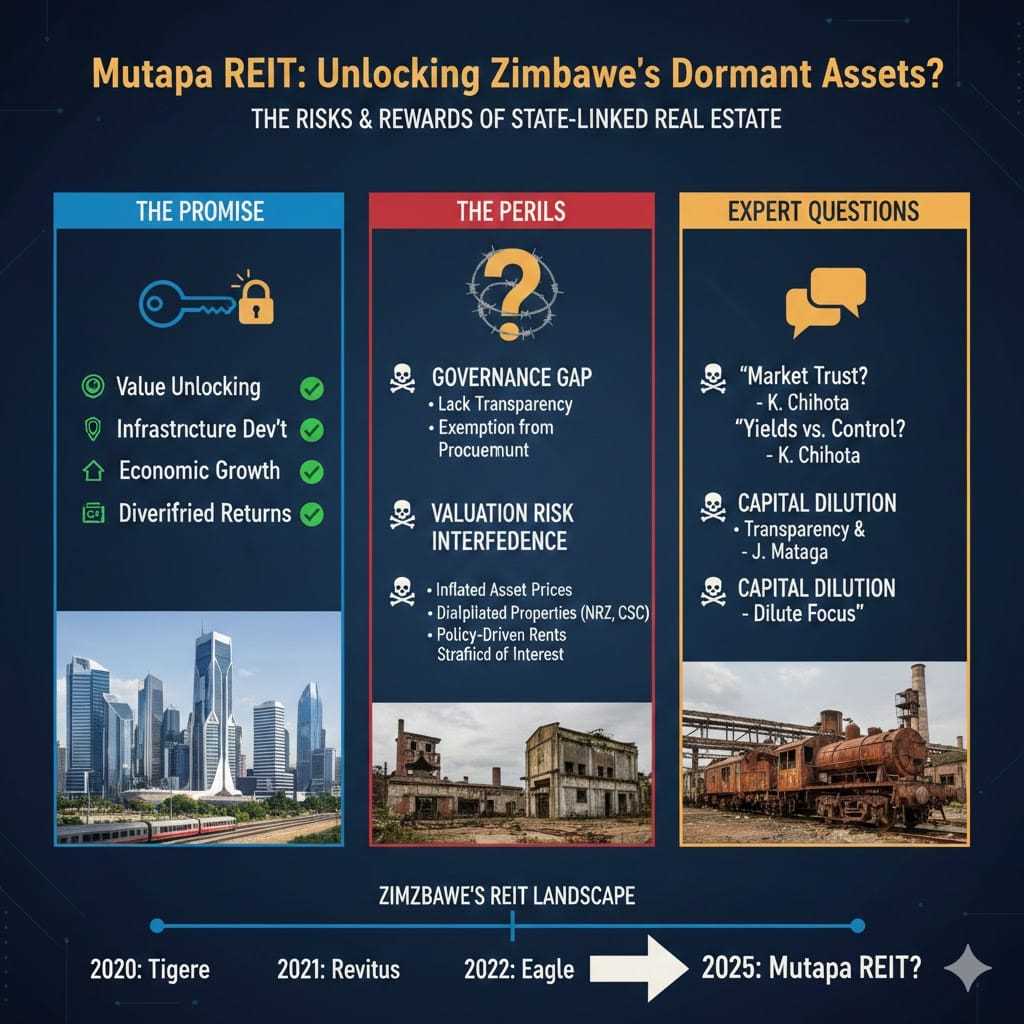
“In consultations with prospective REIT sponsors, I consistently raise five key questions: Does the market trust the sponsor? Can the vehicle deliver market-related yields and development profits?” Chihota said.
He cautioned that REIT sponsors must be prepared to cede management control to an independent REIT manager overseen by a trustee, noting that a REIT structure differs from a conventional company led by a CEO and board.
“The shareholding structure of a REIT is designed to be democratic, typically involving over 100 shareholders for non-pension fund investors. It does not lend itself to familiar control models where shareholding automatically translates into board seats,” Chihota explained.
He also highlighted the challenge of funding growth in a structure that distributes at least 80% of net income to investors, which requires continuous capital raising for new developments.
Chihota questioned the value of tax-exempt status for entities already not subject to taxation, noting that such benefits are clearer for commercial players than for state-linked institutions. Nonetheless, he pointed to regional precedents, such as Tanzania’s Watumhishi Housing REIT and Nigeria’s Ministry of Finance Incorporated Real Estate Investment Fund, as examples of successful public-focused REITs.
Transparency, Valuation, and Political Risk
Customer experience consultant Joseph Farai Mataga said the success of Mutapa’s proposed REIT would hinge on transparency and investor confidence, particularly given past criticism of the fund.
“The Mutapa Fund has faced scrutiny regarding its reporting standards and its exemption from certain procurement laws. If the REIT is not managed with absolute transparency, investors may hesitate to trust the valuation of the assets,” Mataga said.
Related Stories
He warned about the valuation of distressed assets, noting that many government-owned buildings are in poor condition. Injecting such properties into the REIT at optimistic valuations could result in value erosion once maintenance and refurbishment costs are accounted for.
Mataga also flagged political interference as a risk, arguing that for a REIT to function effectively, it must prioritise profits and dividends for unit holders. Policy-driven decisions, such as keeping rents artificially low for certain tenants, could conflict with the REIT’s fiduciary duties.
The Capital Allocation Debate
Another market participant, Tinotenda Kankuni, questioned whether Mutapa’s broad ambitions could dilute focus and strain limited capital.
“The fund seems to be attempting to resuscitate too many assets simultaneously. A more incremental approach—focusing on one financial asset at a time, like phosphate mining at Dorowa—might be more effective,” Kankuni said.
He added that a crowded REIT market raises dilemmas around capital allocation, which is already constrained.
Mutapa’s Strategy
In response, Mutapa Investment Fund said the REIT is intended to consolidate selected real estate assets into a diversified, income-generating vehicle designed to improve asset utilisation, enhance transparency, and deliver sustainable returns.
The initiative is part of a broader strategy to strengthen the performance of the fund’s Real Estate Cluster, leveraging stabilising macroeconomic conditions and renewed investor interest in property assets.
Moderating inflation, stabilisation of the ZiG currency, and improving investor confidence were cited as key factors supporting Zimbabwe’s real estate recovery, helping improve asset pricing and reduce valuation distortions.
The REIT will focus on transforming dormant land and buildings into productive assets through targeted development and active property management, with properties linked to NRZ and CSC expected to form the initial portfolio.
The fund said the REIT structure is designed to provide liquidity and diversification while offering investors exposure to income-producing real estate, building on the growing acceptance of REITs in Zimbabwe.
Mixed Performance Backdrop
Mutapa reported mixed results in 2024: industrial properties delivered strong yields supported by demand from agriculture and mining, while vacancy rates in central business district office spaces remained high.
Despite these challenges, demand across residential, industrial, and mixed-use developments remains resilient. Mutapa indicated that the proposed REIT will be a key tool in repositioning its real estate assets in 2025, aiming to generate stable income streams, support long-term capital growth, and reduce idle property burdens on its portfolio companies.










Leave Comments