





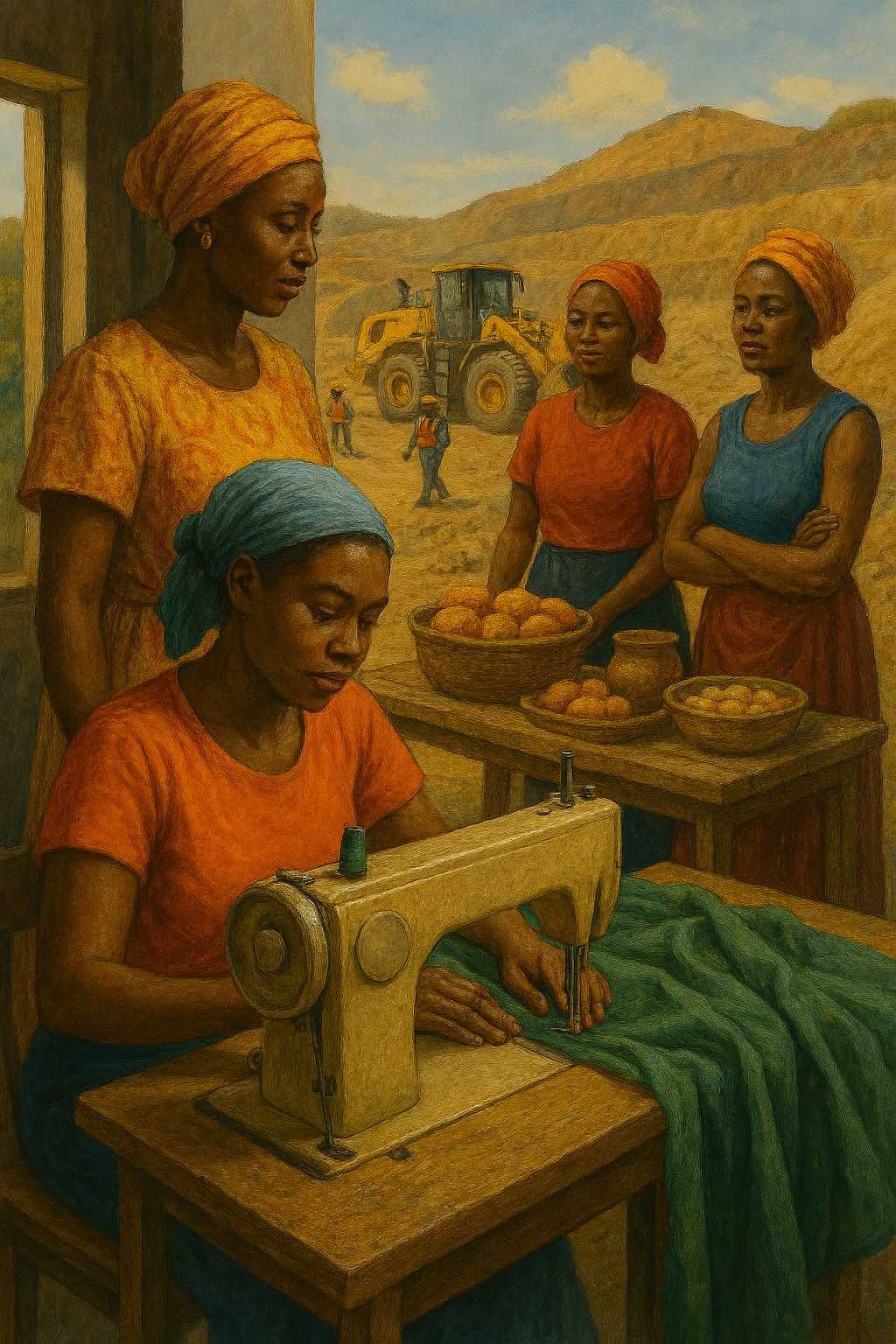
Across Zimbabwe’s lithium belt and other mining districts, a revolution is unfolding at the edges of mining operations.
Where mining towns were once associated with male-dominated labour and limited local opportunity, a growing number of women are now building micro and small businesses that supply and serve the expanding mining economy.
From sewing cooperatives in Goromonzi to food vendors and poultry suppliers in Bikita, women are turning the presence of Chinese-owned mines into sustainable income and greater economic independence.
In Goromonzi, Prospect Lithium Zimbabwe’s Goromonzi Community Development Programme has emerged as a leading example of how deliberate corporate support can ignite women’s entrepreneurship. Launched in December 2024, one of its flagship projects, Weaving the Future Women’s Empowerment, began with six sewing machines and a dedicated group of community women.
Within a year, the initiative had transformed into a fully fledged garment supply business, securing orders worth US$15,000 from clients including Prospect Lithium Zimbabwe, Re Orient, Mustard Seed, the Zimbabwe Republic Police (ZRP) Goromonzi and Chirozva Primary School.
Prospect Lithium Zimbabwe public relations manager Patience Chizodza said the project has become a symbol of what local women can achieve when given opportunity and support.
“After just one year, these women have proven that with determination and hard work, any obstacle can be overcome,” she said. “They are turning the vision of a stronger and more self-sufficient Goromonzi into reality.”
The sewing cooperative’s success has created a ripple effect throughout the district. Inspired by the achievement, other women have formed their own groups and launched new enterprises. One of the most notable developments has been a network of women-run catering groups that emerged during the construction of the Arcadia Technology Plant.
With contractors requiring daily meals, the women organised themselves into structured cooperatives and began supplying freshly prepared food to various crews. Within a year, the catering groups had established reliable income streams and become a significant part of Goromonzi’s local economy.
Related Stories
In Bikita, the presence of Bikita Minerals has also opened new informal and semi-formal income opportunities for women. Local vendors operate daily near the mine, selling food, snacks and basic goods to workers and transport crews. Some have expanded into running canteens or bulk meal preparation for contractors.
One woman, who asked not to be named, started a poultry project specifically to supply chicken for worker meals at Bikita Minerals. Her business began with only a few birds but grew rapidly after she secured consistent demand from the mine. The income from her deliveries now helps her pay school fees, purchase inputs and reinvest in the project, turning what started as a small idea into her household’s main source of income.
In Buhera, the Sabi Star Lithium Mine has created similar economic opportunities. Local women’s groups and small-scale farmers now supply vegetables and other produce used by catering firms that feed mine staff. Some women have transitioned from subsistence farming to market-driven agriculture as a result of having a reliable buyer.
Improved electricity supply in surrounding communities, driven by the mine’s power infrastructure, has also enabled women running salons, tailoring shops and grocery stores to operate for longer hours and reduce losses caused by power cuts.
Across these communities, diverse forms of women’s economic participation are emerging. Some women supply goods directly to the mines, while others run businesses that serve the thousands of people who work in or pass through mining areas.
Sewing groups, poultry farmers, vegetable suppliers, cooks, tailors and general vendors are finding new ways to participate in the local mining economy.
Inside the mines themselves, women are becoming increasingly visible in technical and administrative roles. At Bikita Minerals, for example, women work in laboratories, environmental departments and plant operations. Training initiatives have encouraged more young women to consider careers in engineering and mineral processing, gradually shifting the traditional gender balance within the mining sector.
Although challenges remain, including access to capital and high transport costs, the benefits of mining investment have extended beyond corporate structures. Where companies intentionally support local suppliers, as seen at Prospect Lithium Zimbabwe, women-led businesses grow faster. Where opportunities emerge informally, women respond with creativity, initiative and resilience.
Near the entrance of Bikita Minerals, where women open their vending stalls early each morning, and in sewing rooms in Goromonzi where machines hum late into the afternoon, a new economic story is taking shape.
The rise of women entrepreneurs around Chinese-owned mines shows that large-scale investment, when combined with local enterprise, can create lasting opportunities that strengthen households and uplift entire communities.







Leave Comments