








Newly released British government documents The papers show that the government of then-UK prime minister Tony Blair briefly considered an Iraq-style military intervention to remove President Robert Mugabe.
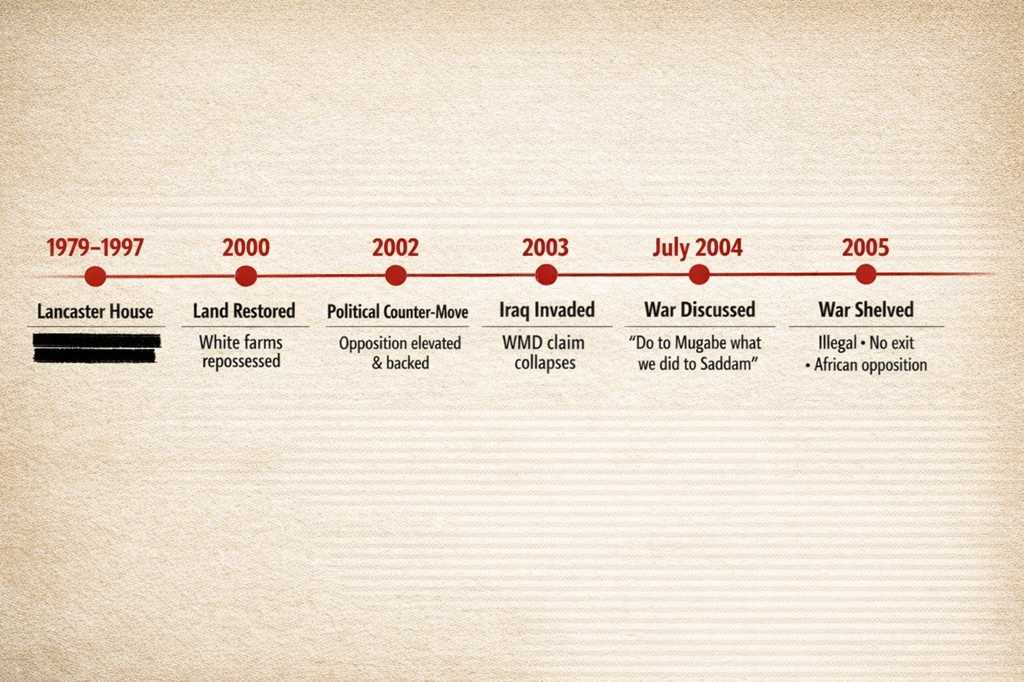
A Foreign Office briefing titled Zimbabwe: Policy Options, dated July 2004, stated bluntly that if Britain truly wanted to change the situation in Zimbabwe, it would have to do “to Mugabe what we have just done to Saddam.”
Cooler heads concluded that such action would be illegal, unworkable, and politically explosive.
The discussions took place after Zimbabwe’s land reform program, a process aimed at restoring land to Black Zimbabweans following a century of settler dispossession, and decades after Britain reneged on its financial obligations under the Lancaster House Agreement to support orderly land redistribution.
When London withdrew funding, Harare proceeded unilaterally, and the result was chaos. That decision fundamentally altered Britain’s posture. Sanctions followed. Diplomatic isolation followed. And, as the newly released documents show, military regime change was put on the table.
The reference in the document pointed directly to the 2003 invasion of Iraq, a war justified by false claims about weapons of mass destruction, which went on to kill hundreds of thousands of civilians, shatter the Iraqi state, destabilize the region, and leave a legacy of violence and sectarian collapse that persists two decades later.
Barely a year after unleashing that destruction, British officials were discussing whether the same logic could be applied to Zimbabwe.
This was a concern about who controlled land, whose property was protected, and whose post-colonial settlement prevailed.
Related Stories
White commercial farming interests and their allies played a central role in the emergence and financing of the Morgan Tsvangirai-led Movement for Democratic Change, which London and its partners quickly elevated as the preferred alternative to ZANU-PF.
Brian Donnelly, the outgoing British ambassador in Harare, told London bluntly that sanctions and pressure had failed to remove Mugabe and that Britain should be prepared to consider “a radical new approach” if he won the 2005 elections.
Yet even Donnelly acknowledged the recklessness of military action.
“Short of a truly catastrophic breakdown in public order, armed intervention is nonsense,” he wrote, adding that even then, any intervention should be African-led, not British.
The Foreign Office itself listed why the idea was indefensible: Britain would likely have to act alone, African states would oppose it, there would be no exit strategy, British nationals would be endangered, and the intervention would be illegal without a UN mandate.
Zimbabwe risked becoming another Iraq because it disrupted entrenched property relations inherited from colonialism. Zimbabwe escaped not due to moral restraint, but because the costs to Britain were judged too high.






Leave Comments