









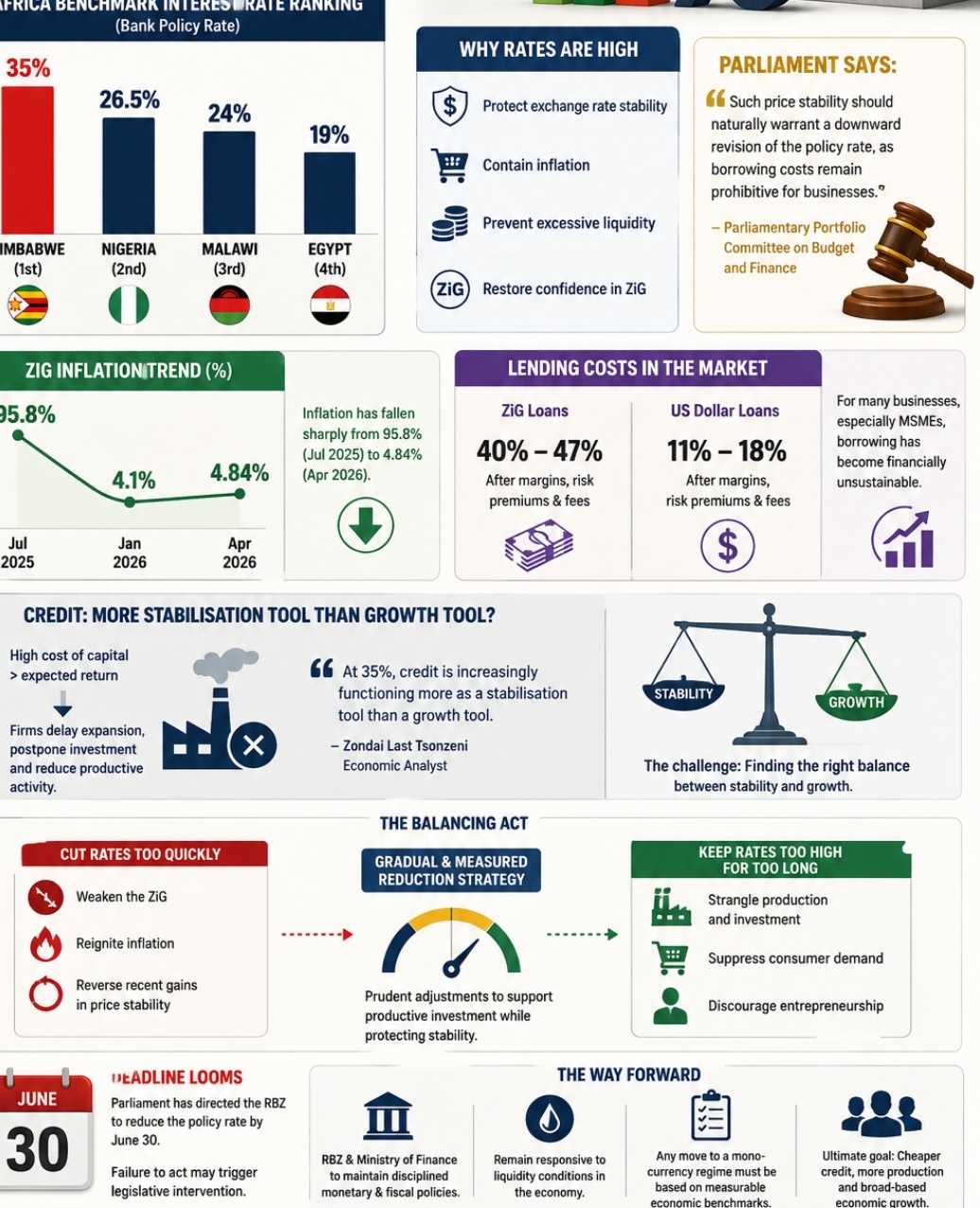
Zimbabwe now holds the unenviable position of having the highest benchmark interest rate in Africa after the Reserve Bank of Zimbabwe maintained its Bank Policy Rate at 35%, according to recent regional data published by Nigerian financial intelligence platform Nairametrics.
The ranking places Zimbabwe ahead of Nigeria at 26.5%, Malawi at 24% and Egypt at 19%.
While authorities argue that the elevated rate is necessary to preserve exchange rate stability and contain inflationary pressures, economists, parliamentarians and industry players increasingly warn that the policy is choking productive sectors and undermining economic recovery.
The debate has now shifted from whether the RBZ succeeded in stabilising the economy to whether the central bank should begin transitioning from a defensive monetary stance towards policies that stimulate growth and investment.
Credit Becoming a "Stabilisation Tool"
Economic analyst and finance commentator Zondai Last Tsonzeni said Zimbabwe's monetary policy is increasingly prioritising currency defence over economic expansion.
"Traditionally, credit is one of the most powerful drivers of economic growth," he said.
"Businesses borrow to expand production, purchase equipment, build inventories, hire employees and invest in innovation. Households borrow to finance homes, education and consumption. In a healthy economy, credit accelerates productivity and growth."
However, with the RBZ benchmark rate sitting at 35%, actual lending costs in the market have surged far beyond the headline figure.
Commercial banks are currently charging between 40% and 47% for ZiG-denominated loans after incorporating margins, risk premiums and fees, while United States dollar loans range between 11% and 18%.
For many companies, particularly micro, small and medium enterprises (MSMEs), borrowing has become financially unsustainable.
"When the cost of capital exceeds the expected return on investment, firms delay expansion, postpone investment decisions and reduce productive activity," Tsonzeni said.
He argued that the current framework has succeeded in slowing inflation and supporting the ZiG currency, but at a steep cost to productive sectors.
"At 35%, credit is increasingly functioning more as a stabilisation tool than a growth tool," he said.
"The next phase of monetary policy may require a gradual transition from protecting stability to enabling sustainable growth."
In May, the Parliamentary Portfolio Committee on Budget and Finance directed the RBZ to reduce the policy rate by June 30, arguing that current borrowing costs are no longer justifiable given the dramatic slowdown in inflation.
According to the committee's 2026 Monetary Policy Report, annual ZiG inflation declined sharply from 95.8% in July 2025 to 4.1% in January 2026 before edging up slightly to 4.84% in April.
Lawmakers argued that maintaining a 35% benchmark rate under such conditions risks suppressing industrial productivity and weakening economic activity.
"Such price stability should naturally warrant a downward revision of the policy rate, as borrowing costs remain prohibitive for businesses seeking to finance capital and working capital requirements," the committee said.
Industry participants had expected the RBZ to reduce the benchmark rate to around 30% as a signal of improving macroeconomic confidence and easing inflation concerns.
Instead, authorities retained the 35% rate, reflecting what Parliament described as the central bank's "cautious stance" amid fears of renewed inflationary pressures.
The committee argued that the gap between inflation and interest rates now appears excessive compared with regional peers.
"A 35% policy rate against 4.84% inflation appears disproportionate when compared with regional peers," the report stated.
Why the RBZ Remains Cautious
Despite mounting pressure for rate cuts, the RBZ remains wary of Zimbabwe's long history of hyperinflation, exchange-rate volatility and repeated currency collapses.
Related Stories
The ZiG currency, introduced in 2024 as Zimbabwe's latest attempt at monetary reform, initially faced scepticism from businesses and consumers after years of instability involving previous local currency systems.
Authorities believe tight monetary policy has helped restore some confidence in the exchange rate while reducing speculative borrowing and excessive liquidity growth.
The Parliamentary Portfolio Committee itself acknowledged that the RBZ's 2026 Monetary Policy Statement had become a "credibility instrument" for stabilising exchange-rate expectations.
The committee also welcomed supporting measures introduced by the central bank, including reductions in bank charges and increased mobile money transaction limits.
Economists say the RBZ's reluctance to aggressively cut rates stems from fears that premature easing could destabilise the ZiG, reignite inflation and reverse recent gains in price stability.
Zimbabwe's economic authorities have repeatedly emphasised that inflation management and currency stability remain their top priorities after decades of monetary instability damaged savings, investment confidence and industrial productivity.
Industry Caught Between Stability and Growth
Business leaders, however, argue that excessive monetary tightening may itself become economically damaging.
Manufacturers and retailers say access to affordable capital is critical for restocking, expansion, machinery upgrades and increasing local production.
At current lending rates, many firms are either avoiding borrowing altogether or relying heavily on short-term, expensive financing.
Economists warn that prolonged high borrowing costs could slow industrial recovery, suppress consumer demand and discourage entrepreneurship.
The policy environment has created a difficult balancing act for authorities:
Cutting rates too quickly could weaken the ZiG and reignite inflation.
Keeping rates too high for too long could stifle production and investment.
The Parliamentary Portfolio Committee has therefore recommended a gradual and measured reduction strategy.
"Gradual downward adjustments would be prudent, balancing the need for caution with the imperative of supporting productive investment," the committee said.
Regional Comparison Increases Pressure
Zimbabwe's benchmark rate now stands significantly above those of most African economies, increasing scrutiny over the sustainability of the country's current monetary policy settings.
Regional comparisons show that countries with relatively stable inflation environments generally maintain substantially lower policy rates.
For example, South Africa has largely operated with single-digit to low double-digit interest rates under comparatively stable inflation conditions.
Analysts say Zimbabwe's unusually high rates reflect the country's unique monetary vulnerabilities rather than conventional economic growth priorities.
Nevertheless, pressure is mounting on the RBZ to demonstrate that stabilisation policies can eventually translate into cheaper credit, increased production and broader economic expansion.
June 30 Deadline Looms
The Parliamentary Portfolio Committee warned that if the RBZ fails to respond by June 30, legislators may consider pursuing legislative intervention to force borrowing costs lower.
The committee also urged both the RBZ and the Ministry of Finance to maintain disciplined monetary and fiscal policies while remaining responsive to liquidity conditions in the economy.
It further cautioned that any future transition towards a mono-currency regime should be based on measurable economic benchmarks rather than political timelines.









Leave Comments