








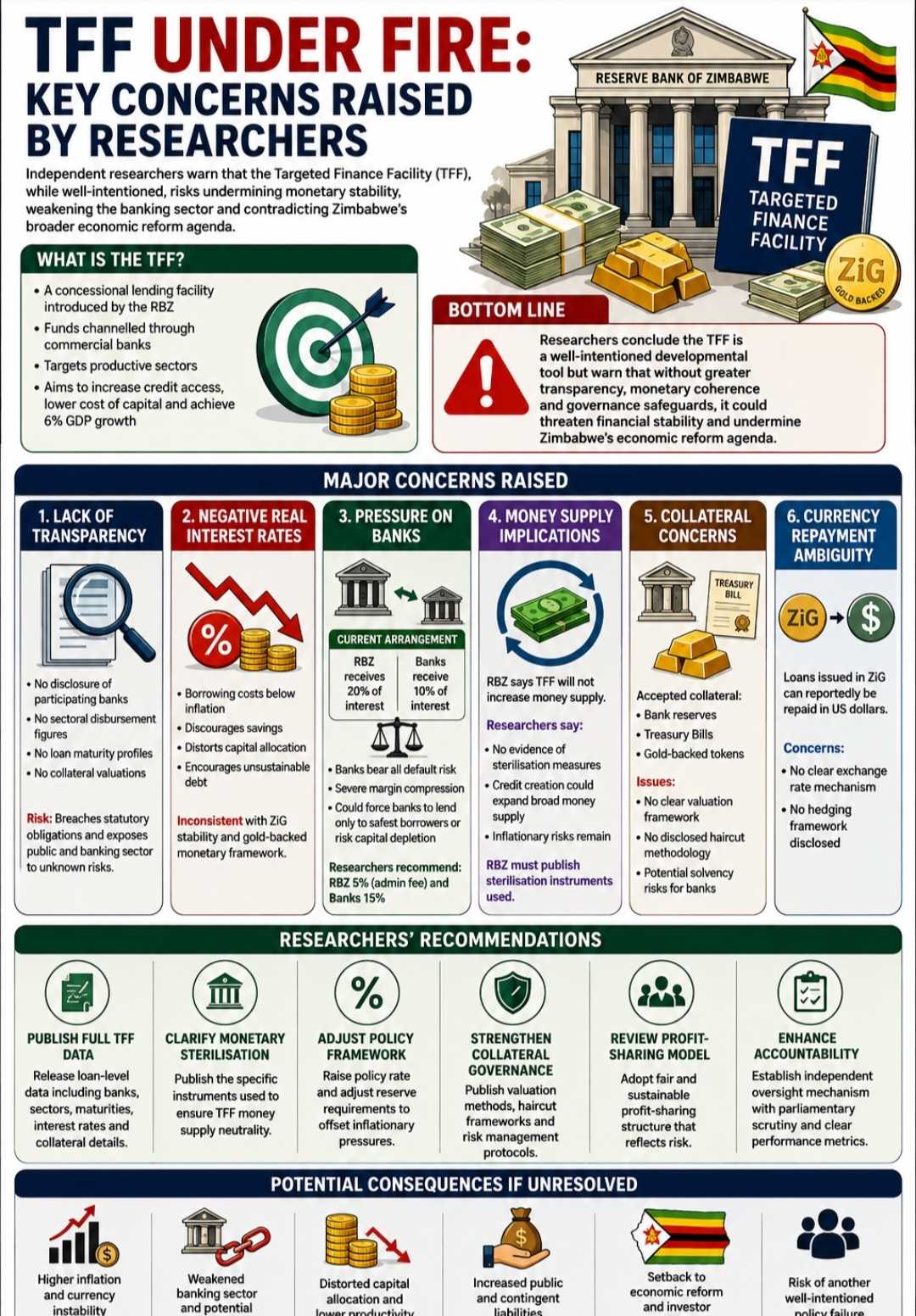
Zimbabwe’s Targeted Finance Facility has come under sharp scrutiny from independent economic researchers, who argue that the Reserve Bank of Zimbabwe’s flagship concessional lending programme risks undermining monetary stability, weakening the banking sector and contradicting the country’s broader economic reform agenda.
In a detailed policy analysis released in May 2026, titled “Targeted Finance Facility Is Inconsistent With Monetary Policy Mandate”, researchers said the TFF, although designed to stimulate productivity and help achieve 6% GDP growth, contains “structural contradictions” that could destabilise the economy if left unresolved.
The paper examines the TFF’s lending structure, transparency standards, collateral arrangements, interest rate framework and money supply implications, concluding that the programme “misaligns risk and reward, introduces negative real interest rate dynamics, lacks transparency on monetary sterilisation, and risks destabilising the banking sector it seeks to leverage.”
The TFF was introduced by the Reserve Bank of Zimbabwe as a concessional lending facility channelled through commercial banks to productive sectors, with the stated objective of increasing credit access, lowering the cost of capital and stimulating economic growth.
However, the report argues that the facility’s design conflicts with the central bank’s own monetary stability mandate under the Zimbabwe Gold (ZiG) framework.
Researchers said one of the most serious concerns is the absence of transparency around the programme. According to the report, the RBZ has not published critical information including the identities of participating banks, sectoral disbursement figures, maturity profiles of loans and collateral valuations.
The paper argues that this lack of disclosure may breach statutory obligations under the RBZ Act, particularly where public funds or contingent liabilities are involved.
Researchers also warned that the absence of “collateral equilibrium” data makes it impossible for Parliament, the public or financial markets to assess the true level of taxpayer and banking sector exposure.
A major criticism centres on the facility’s concessional interest rate structure. The report says the TFF effectively creates negative real interest rates because borrowing costs are set below prevailing inflation levels.
Researchers warned that while this may stimulate short-term borrowing and spending, it discourages savings, distorts capital allocation and encourages unsustainable debt accumulation.
The paper further states that negative real rates are inconsistent with the RBZ’s efforts to stabilise the ZiG currency through a gold-backed monetary framework.
“One cannot simultaneously anchor a currency to gold and underwrite concessional lending at rates that penalise savings and reward over-leverage,” the report states.
Related Stories
The study also raises concerns about pressure being placed on commercial banks participating in the programme. Researchers argue that banks are being squeezed between concessional borrowing costs imposed by the RBZ and capped on-lending rates to borrowers, resulting in severe margin compression.
According to the report, the situation is worsened by the current profit-sharing arrangement under which the RBZ receives 20% of interest generated by TFF loans while commercial banks retain 10%, despite banks carrying all borrower default risk.
The researchers described the arrangement as “economically irrational,” warning that it could either force banks to lend only to the safest borrowers — undermining the programme’s developmental objectives — or expose smaller banks to capital depletion and instability if defaults rise.
The paper proposes reversing the arrangement so that participating banks receive 15% while the RBZ retains a 5% administrative fee.
The report also challenges the RBZ’s assertion that the TFF “will not lead to a rise in the money supply.” Researchers argue that unless the central bank actively sterilises liquidity injections through higher reserve requirements or open market operations, the facility could expand broad money supply through the normal credit multiplier effect.
“The RBZ must, as a matter of urgency, publish the specific sterilisation instruments being used to ensure TFF money supply neutrality,” the report said.
Further concerns were raised over collateral governance and repayment arrangements. The paper notes that the facility accepts reserves, treasury bills and gold tokens as collateral, but lacks clear valuation methodologies and haircut frameworks.
Researchers warned that commercial banks pledging reserves against TFF borrowings could expose themselves to solvency risks in the event of widespread defaults.
The report also criticised ambiguity around repayment terms where loans disbursed in ZiG may be repaid in United States dollars without a clearly defined exchange rate mechanism or hedging framework.
Operational governance gaps identified in the study include unclear definitions of “productive sectors,” inadequate borrower monitoring mechanisms, lack of clarity on unused funds and the absence of measurable performance indicators or accountability systems for participating banks.
Researchers warned that if producers borrow at effective rates above 30%, they may struggle to compete against informal sector imports from neighbouring countries, limiting the programme’s intended economic stimulus effect.
Among several recommendations, the report calls for immediate publication of loan-level TFF data, adjustments to reserve requirements, a higher policy rate to offset inflationary pressure, publication of a detailed collateral governance framework and establishment of an independent accountability mechanism with parliamentary oversight.
The paper further states that while the TFF is a “well-intentioned developmental instrument,” its current structure falls short on transparency, monetary coherence and governance standards.
Researchers warned that Zimbabwe “cannot afford another well-intended policy that fails in execution.”









Leave Comments