







By Simbarashe Namusi
Many Zimbabweans already understand something about power in this country, even if they have never studied political science.
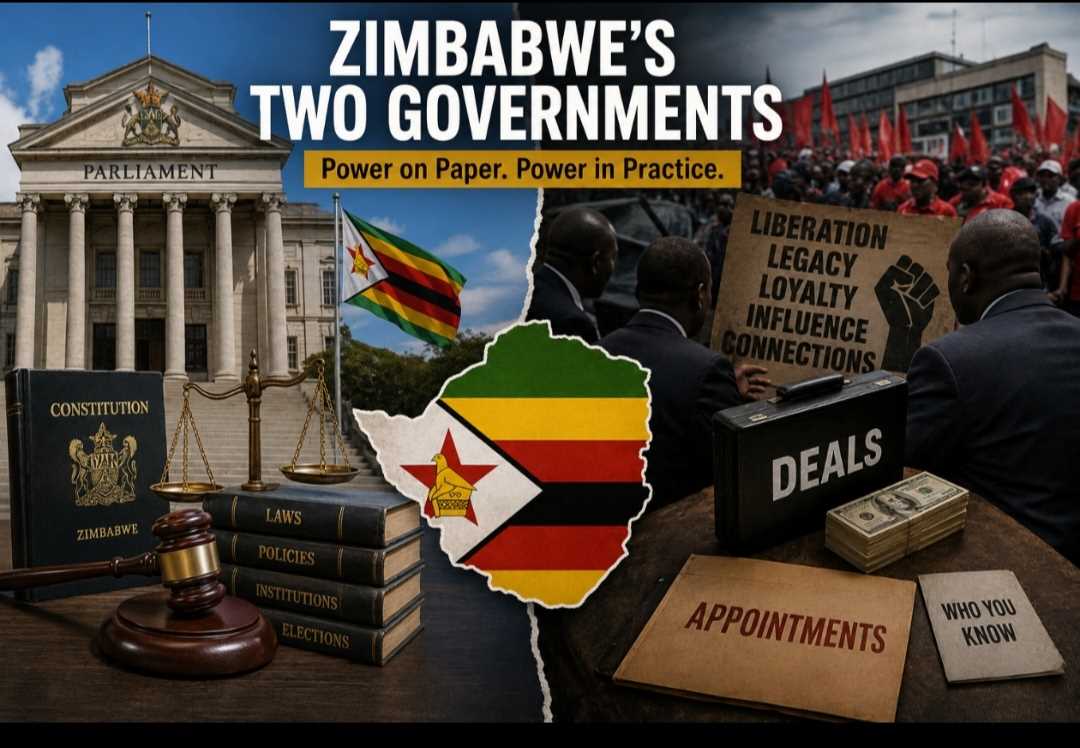
They know there is the government that exists on paper — with Parliament, the courts, ministers, local authorities, elections and the Constitution.
Then there is the other government: the one built around liberation history, political connections, party loyalty, influence and who knows whom.
This is precisely the kind of system political scientist David Apter sought to explain decades ago through what he called the "dichotomy of power."
The term may sound complicated, but the idea behind it is straightforward.
Apter argued that many African countries operate with two forms of authority simultaneously. The first is formal power: laws, institutions, constitutions and democratic systems. The second is informal power: liberation credentials, political loyalty, patronage networks, personalities and historical legitimacy.
Zimbabwe fits this description remarkably well.
Since independence in 1980, the country has never been governed solely through institutions. It has also been governed through the moral and political weight of the liberation struggle.
That history matters deeply. It shaped the nation and secured Zimbabwe's independence. But over time, liberation legitimacy became more than a historical legacy. It became political currency.
In Zimbabwe, power is not always measured solely through elections or constitutional authority. It is often measured through liberation credentials, proximity to power and political loyalty.
That is why many Zimbabweans speak about "the party" and "the government" almost interchangeably.
It is also why people sometimes feel that, even when institutions exist, real decisions are made elsewhere.
A council office may exist, but politics often influences how it operates. A government tender may be publicly advertised, yet people still ask who is connected to whom. An appointment may follow legal procedures, but citizens frequently suspect political calculations behind it.
Ordinary Zimbabweans understand this reality better than many academics.
They experience it when seeking opportunities. They see it in the overlap between business, politics and influence. They hear it in political speeches where criticism of government is sometimes portrayed as criticism of the liberation struggle itself.
In Zimbabwe, legality and legitimacy do not always mean the same thing.
This tension helps explain why politics in the country often feels larger than policy. Debates about roads, corruption, elections or constitutional amendments quickly become debates about patriotism, sovereignty and national identity.
That is because Zimbabwe's politics were shaped not only as a democratic project but also as a liberation project.
Like many post-colonial African leaders, Zimbabwe's leadership inherited a difficult balancing act after independence: how to modernise the country while preserving national unity and maintaining political control.
Related Stories
Over time, power became increasingly centralised.
Supporters argue that strong central authority protected Zimbabwe from instability, foreign interference and political fragmentation. Critics contend that it weakened institutions, reduced accountability and blurred the distinction between party and state.
Both arguments, in different ways, reinforce Apter's theory.
The result is a country that often appears to operate through two systems at once.
One system is constitutional and bureaucratic.
The other is political and informal.
One exists in law.
The other exists in practice.
This contradiction is also visible in the economy.
Zimbabwe frequently speaks the language of reform, investment and development. Yet economic opportunities are often viewed through the lens of political relationships and elite networks. Merit and connection sometimes compete against each other rather than working together.
For many young Zimbabweans, this creates frustration.
A generation born long after independence continues to live within political structures heavily shaped by liberation-era thinking. Yet their daily realities are very different. They are more connected to social media than political rallies. They debate politics on WhatsApp, Facebook, TikTok and X. Many are more concerned with economic opportunity than ideological battles.
The old political language does not always resonate with their lived experiences.
At the same time, Zimbabweans have become remarkably adaptable. Many survive through informal trading, cross-border commerce, migration, side businesses and digital innovation. They have learned to navigate both the formal and informal systems simultaneously.
Perhaps that is why Apter's theory remains relevant today.
It explains why Zimbabwe can possess strong institutions on paper while many citizens still believe that real power operates through relationships and political influence. It explains why constitutional debates are often emotional and historical rather than purely legal.
Most importantly, it helps illuminate one of the country's most enduring questions:
Who truly governs Zimbabwe — institutions or political legitimacy?
That question lies beneath almost every national conversation, whether about elections, economic reform, succession politics or constitutional change.
Zimbabwe's future may ultimately depend on whether its institutions can one day stand fully on their own, without continually relying on liberation-era political authority for legitimacy.
Until then, many Zimbabweans may continue to feel as though they live under two governments at once: the one written in the Constitution and the one everyone quietly understands.
Simbarashe Namusi is a peace, leadership and governance scholar, as well as a media expert, writing in his personal capacity.





Leave Comments