








A High Court judgment has ordered Zimnat General Insurance to pay more than US$2,4 million to two Victoria Falls-based tourism operators, after the court ruled that Covid-19-related business interruption losses were indeed covered under their insurance policies.
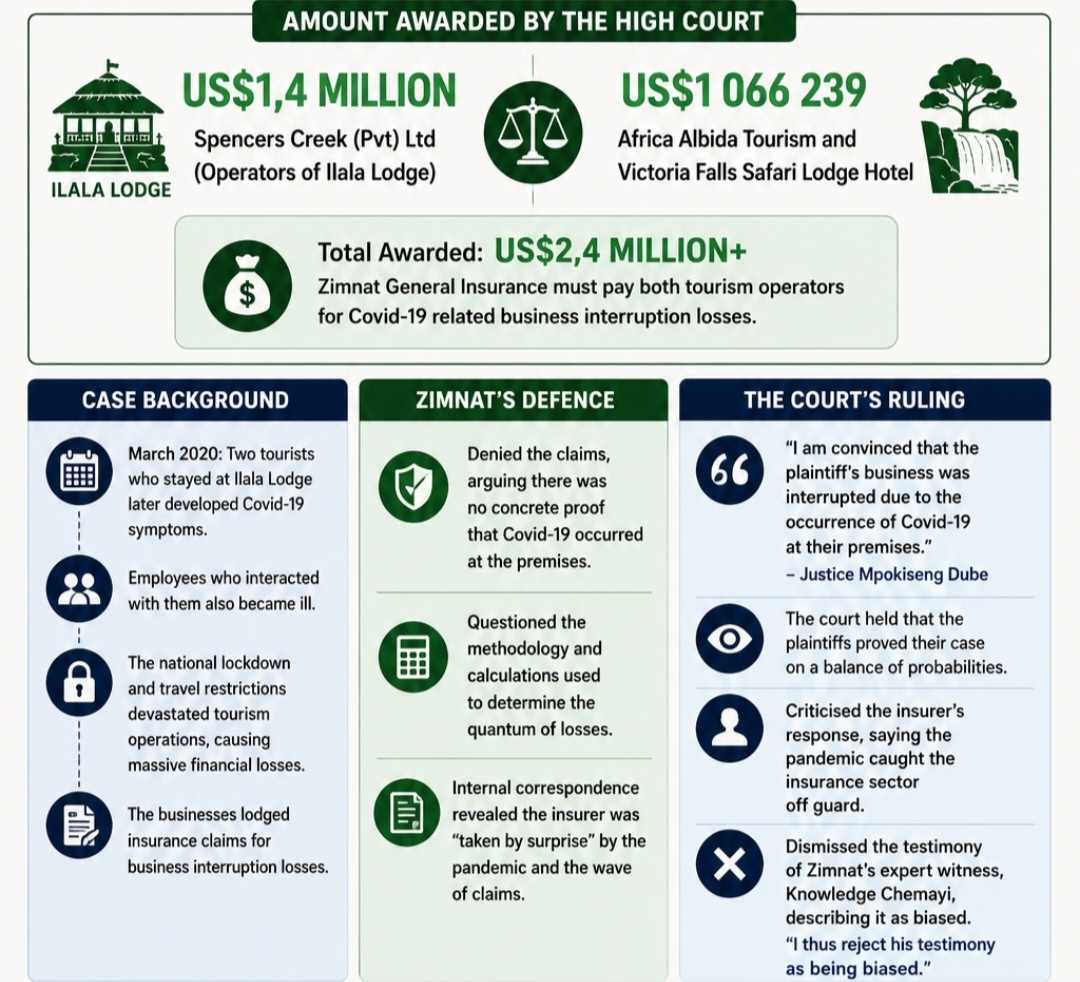
The ruling, delivered in Bulawayo by Justice Mpokiseng Dube, awarded US$1,4 million to Spencers Creek (Pvt) Ltd, operators of Ilala Lodge, and a further US$1 066 239 to Africa Albida Tourism and Victoria Falls Safari Lodge Hotel.
The case arose from claims linked to severe business disruptions suffered during the 2020 Covid-19 pandemic and nationwide lockdowns, which brought Zimbabwe’s tourism industry to a near standstill.
Court papers showed that two tourists who stayed at Ilala Lodge in March 2020 later exhibited Covid-19 symptoms, with staff members who had interacted with them also falling ill. The plaintiffs argued that this constituted an insured “occurrence” under their business interruption policies.
Zimnat, however, rejected the claims, arguing that there was no definitive proof that Covid-19 had occurred on the premises and challenging the methodology used to quantify the losses.
Related Stories
Justice Dube, in his ruling, found that the plaintiffs had met the required legal threshold, concluding that their businesses were indeed interrupted due to the presence of Covid-19 at their premises.
“I am convinced that the plaintiff’s business was interrupted due to the occurrence of Covid-19 at their premises,” the judge said.
The court further noted that the insurer appeared unprepared for the scale and nature of pandemic-related claims, suggesting the industry had been caught off guard by the unprecedented global health crisis.
“What this letter tells in plain truth is that the defendant in its position as an insurer was taken by surprise by the pandemic and resultant claims,” Justice Dube observed.
The judgment also dismissed expert testimony presented by Zimnat, with the court describing it as lacking independence.
“I thus reject his testimony as being biased,” the ruling stated.
The decision is expected to have wider implications for the insurance sector, particularly around the interpretation of business interruption policies in the context of systemic risks such as pandemics, where coverage wording and exclusions are increasingly coming under judicial scrutiny.










Leave Comments