








The Labour Court has struck off an application seeking to load a US$586,000 damages claim and extensive vehicle-related demands onto a default judgment against the National Pharmaceutical Company of Zimbabwe, ruling that the bid was procedurally incompetent and brought under the wrong provision of the law.
The court dismissed an application by former NatPharm employee Zealous Nyabadza, who sought to alter a default judgment previously granted in his favour. The court ruled that the application was incompetent and improperly framed.
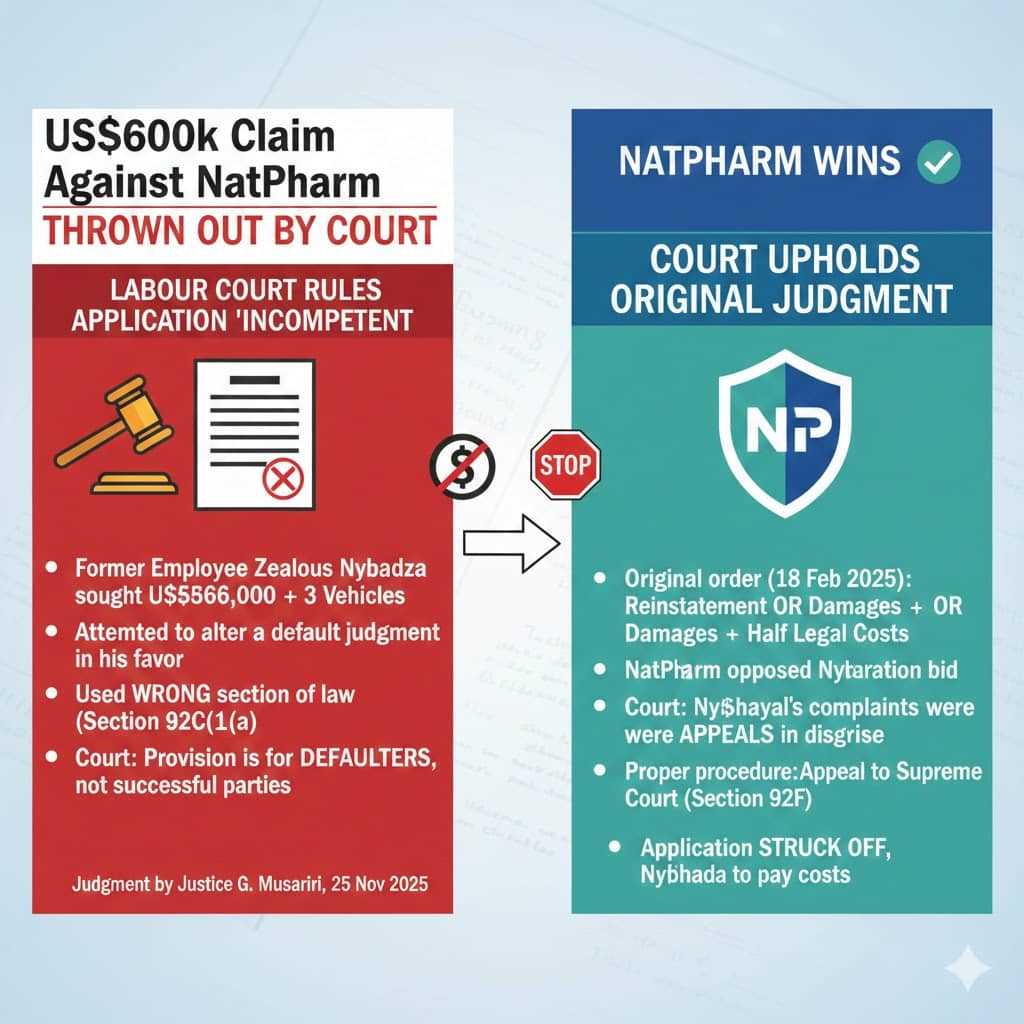
In a judgment delivered on 25 November 2025, Justice G. Musariri held that Nyabadza had wrongly invoked section 92C(1)(a) of the Labour Act — a provision reserved for parties against whom a default judgment has been granted. Nyabadza, however, was the successful party in the original proceedings.
Nyabadza had approached the court seeking to alter a default judgment issued on 18 February 2025 under case number LCH 857/22-1, in which NatPharm was ordered to either reinstate him without loss of salary and benefits or pay damages in lieu of reinstatement. The company was also ordered to pay half of his legal costs.
In his latest application, Nyabadza argued that the earlier judgment failed to pronounce itself on several issues he had raised, including points in limine, the alleged lack of authority of the respondent’s deponent, and alleged breaches of corporate governance laws.
He sought, among other relief, damages amounting to US$586,376 linked to his contract as Information Technology Manager, ownership of a company vehicle, and an order compelling NatPharm to purchase two brand-new replacement vehicles valued at US$71,000 each or pay their cash equivalent, together with interest and inflation-indexed compensation.
Related Stories
Nyabadza argued that because the respondent had been barred and its opposing papers expunged, the matter constituted a default judgment and that the court should have granted the full relief sought. He contended that the judgment was not on the merits and could therefore be corrected through an alteration application.
NatPharm opposed the application, arguing that section 92C(1)(a) was not available to a party who had succeeded by default and that Nyabadza’s application amounted to an appeal disguised as an application for rescission or variation. The respondent maintained that the court had properly addressed the issues before it.
In its analysis, the Labour Court agreed with NatPharm, finding that Nyabadza’s complaints were framed as alleged errors by the court rather than matters arising from a default. The court held that such complaints fall under section 92C(1)(c) of the Labour Act, not section 92C(1)(a), which exists for the benefit of a defaulting party.
Justice Musariri further ruled that there was no patent or obvious error in the earlier judgment. Instead, the court found that Nyabadza was dissatisfied with the outcome and was attempting to reopen the merits of the decision through an improper procedure.
“The applicant was not the defaulting party,” the court held, adding that any challenge to the substance of the judgment should have been pursued by way of an appeal to the Supreme Court in terms of section 92F of the Labour Act.
As a result, the application for alteration of the court order was struck off as incompetent, with Nyabadza ordered to pay the respondent’s costs of suit.










Leave Comments