









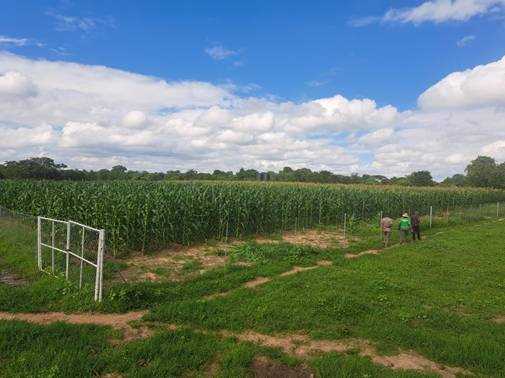
Nkayi is the kind of place associated with drought, writing the calendar, and ambitious young people leaving before they finish growing up. Farming is a desperate act of survival, which usually ends in bleak disappointment and the resort to other means.
And yet, on a small patch of land in Mbunde Village, Skopo Ward 15, 1.25 hectares of land have been turned into a business.
On 1 February 2025, the Chibini Village Business Unit opened its gates as a working rural enterprise, built and owned by the community itself.
Thirty villagers came together. Eighteen women and twelve men, including ten young people, organized into an institution, wrote a constitution, elected leadership, and began to act to ensure that their land feeds and pays them.
Where Climate Change Meets Its Match
Matabeleland North has never been generous with rain. Now climate change has made it even more unpredictable.
Chibini no longer waits for the clouds. A solarized borehole turns sunlight into water, pumping life into the soil without burning fuel or money. The hum of the pump has become the sound of hope and the certainty of a better tomorrow.
Where dust once ruled, rows of food now stand in disciplined lines. Green mealies rising confidently. This is climate-smart agriculture in motion.
The Business of Being Rural
What makes Chibini different is that villagers are not just left to toil without requisite support systems. They are training with AGRITEX and ARDAS and learning water management with ZINWA while preparing for mechanization with RIDA.
Related Stories
Chibini is also ensuring that women claim their share of economic empowerment, with eighteen women forming the backbone of the operation, managing production, finance, and governance.
It is also giving a viable option to young people in a country where youth unemployment is measured in millions, as they can now see agriculture as a possibility with the right skills that turn land into income.
A Food Ecosystem, Not Just a Field
Zimbabwe’s food story is fragile. Drought sends prices soaring. Imports drain foreign currency. Households walk a thin line between enough and hunger.
Chibini is building resilience in an area that desperately needs it. Supported by the Smallholder Agriculture Cluster Project and the Ministry of Lands, Agriculture, Fisheries, Water, and Rural Development, the village is laying the foundations of a local food ecosystem. Production. Irrigation. Skills. Governance. Market access.
While this is a very small project impacting a very minor percentage of the district’s population and possibly not significant in numbers at the national level, it is scalable and can be replicated across the country.
A Village That Became an Investment
On 1.25 hectares, Chibini is feeding households, creating income, training youth, empowering women, and rebuilding faith in rural economies.
This is poverty alleviation with structure, climate action with real harvests, and youth employment with payslips.
This is rural regeneration with receipts.










Leave Comments